Your foundation to actually earning the top 3 of Google instead of fighting to death for ad space with your competitors.

Monty K
Your Unfair Advantage For A Spot At The Top
The Blueprint for Local Domination: Why Keyword and Competitor Research is the Foundation of Your Success
You offer an exceptional customer service, have with highly skilled technicians, and take pride in serving your local community. You’ve probably already invested in Google business profile optimisation and perhaps you’re running some ads.
Despite this, you look at the top 3 of Google (Article 3 placeholder) map results for your services, and you see the same two or three competitors dominating. They're getting the clicks, calls, premium jobs and leaving you with leftovers or forcing you to fight and play a dirty advertising battle.
Google doesn't care how long they've been in business for, so why are they still there?
These businesses are likely optimizing for the exact terms your potential customers are actually typing into Google. Meanwhile, your operating on guesswork, limiting beliefs and assumptions instead of viewing reality for what it is.
If you are ready to leave survival-mode operation and truly scale, then you must understand that local marketing doesn't start with a pretty website or a random post on social media.
You must start with data. Yes, the tedious, professional and annoying deep-dive, local keyword analysis and competitor research. And if you or your marketing agency tries to ignore the data, then you are gambling instead of relying on strategy.
Are you playing a Guessing Game that Loses You Customers?
If you ask most local business owners, what keywords do they rank for, they will immediately say "[My Service] in [My City]." So if you run a Roof Repair Business in Parramatta, you'll assume people only search for "roof repair Parramatta."
And these 2 reasons is why it all falls apart:
High Competition: Every Roof Repair Business is fighting for that one broad term. It’s hard to rank, and it definitely isn't the most valuable search term or query.
Missing Audiences: You are missing Customers that have already gone through the research phase and want a specific service. That means services like Roof Restoration, Colouring, Pressure Washing, Tile Replacement and Maintenance are all being missed. You do offer these services too right?
You are missing the hundreds of jobs and telling the world these are not services you offer. So what does Google do? Hand these high-intent, high-profit customers and jobs DIRECTLY to your competitors.
"Emergency roof leak repair," "best value gutter replacement," or "terracotta roof tile restoration near me." These are services you offer right? These are jobs for your team and hundreds of people are searching for them right?
Professional Keyword Research stops this from happening and makes sure that you catch these jobs too.
It moves your business from the guessing game of "we think people search this" to "we know people search for this, and this is exactly how much traffic it can generate for us."
What Exactly does Local Keyword Analysis mean for you? (Moving Beyond "Plumber in [City]")
If you have no knowledge what a keyword is then you'll probably think Keyword Analysis is just nerding out over a list of words that are related to your topic. Keywords are actually the language used by your customers, understanding what happens in certain locations (Location Dynamics), and what motivates searchers to look for you.
For your Local service businesses, finding out which keywords and how they move the needle requires you look through the special lens called Explicit Search and Implicit Search.
Explicit vs. Implicit Local Search
"Why" someone has searched something is called Search Intent.
So when someone searches for a service in their local area, it's important to see it two key ways: Explicit and Implicit.
Explicit Search: The customer searching searches with a location. (e.g., "emergency electrician Blacktown").
Implicit Search: The customer searches for a service without a location, but Google uses their GPS data to provide local results. (e.g., "electrician near me" or simply "flickering lights").
When you research Keywords, you must get data on Explicit AND Implicit Searches.
This means how often people in specific postcodes are people searching for your services. You also need to know what questions they will usually ask when they are in the 'discovery' phase before they make a decision. Master this and congratulations, you now have a client!
This diagram below explains Local Search Intent Visually.
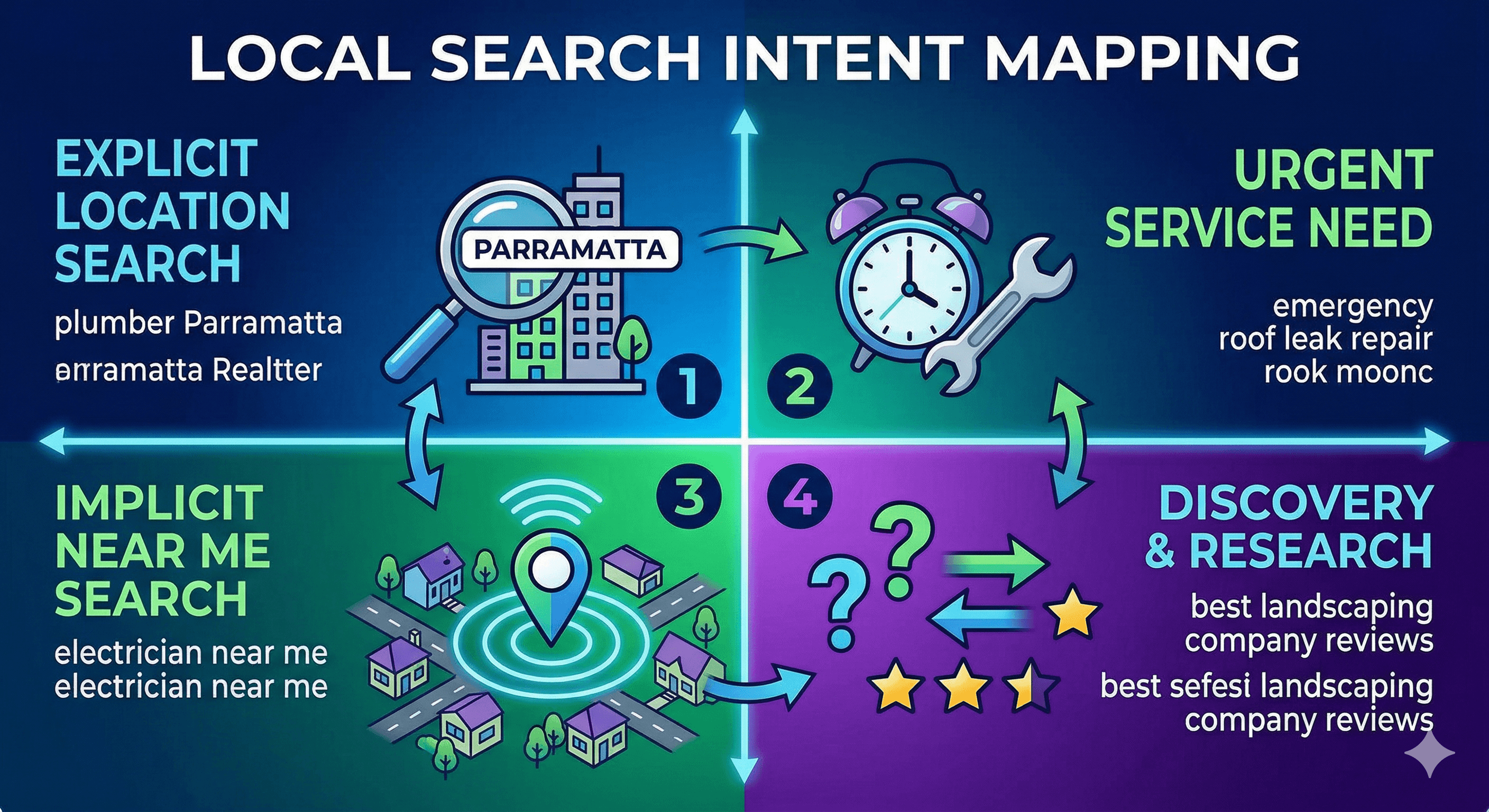
Yeah that was a lot of theory. The key takeaway is simple geography isn't enough to rank in the Top 3. You are targeting a mindset and customer psychology, not just a location.
Your Unfair Advantage in the Local Market: Competitor Research
You've probably heard of the 80/20 rule. The Pareto Principle. In any given area, 1-2 companies usually capture 80% of the organic search traffic for their industry, whilst everyone else is left fighting for the remaining 20% How do they do it?
Your Weapon To Beat Competitors is to Analyse Them
And most people just "Look" at their competitors website or social media profile. Instead, if you systematically deconstruct their entire digital footprint, you'll learn exactly how to beat them. Our Marketing Agency analyses:
Ranking footprint: What hundreds of keywords have they chosen to rank for?
Backlink profile: Who is vouching for them online? (What citations, links and directories are they relying on?)
Content strategy: What questions do their customers have? Are they answering questions that you are not?
GBP Strategy: How are they leveraging reviews, posts, and category nesting to maintain a their dominating presence?
Sharpen Your Sword: How To Find the Gaps They Aren't Filling
When analysing competitors, your goal is to find "blind spots." What are they missing? These are opportunities you can claim!
Perhaps they focus only on explicit city intent searches but have ignored implicit intent searches?
Maybe they are ranking for services offered but haven't optimized specific suburbs?
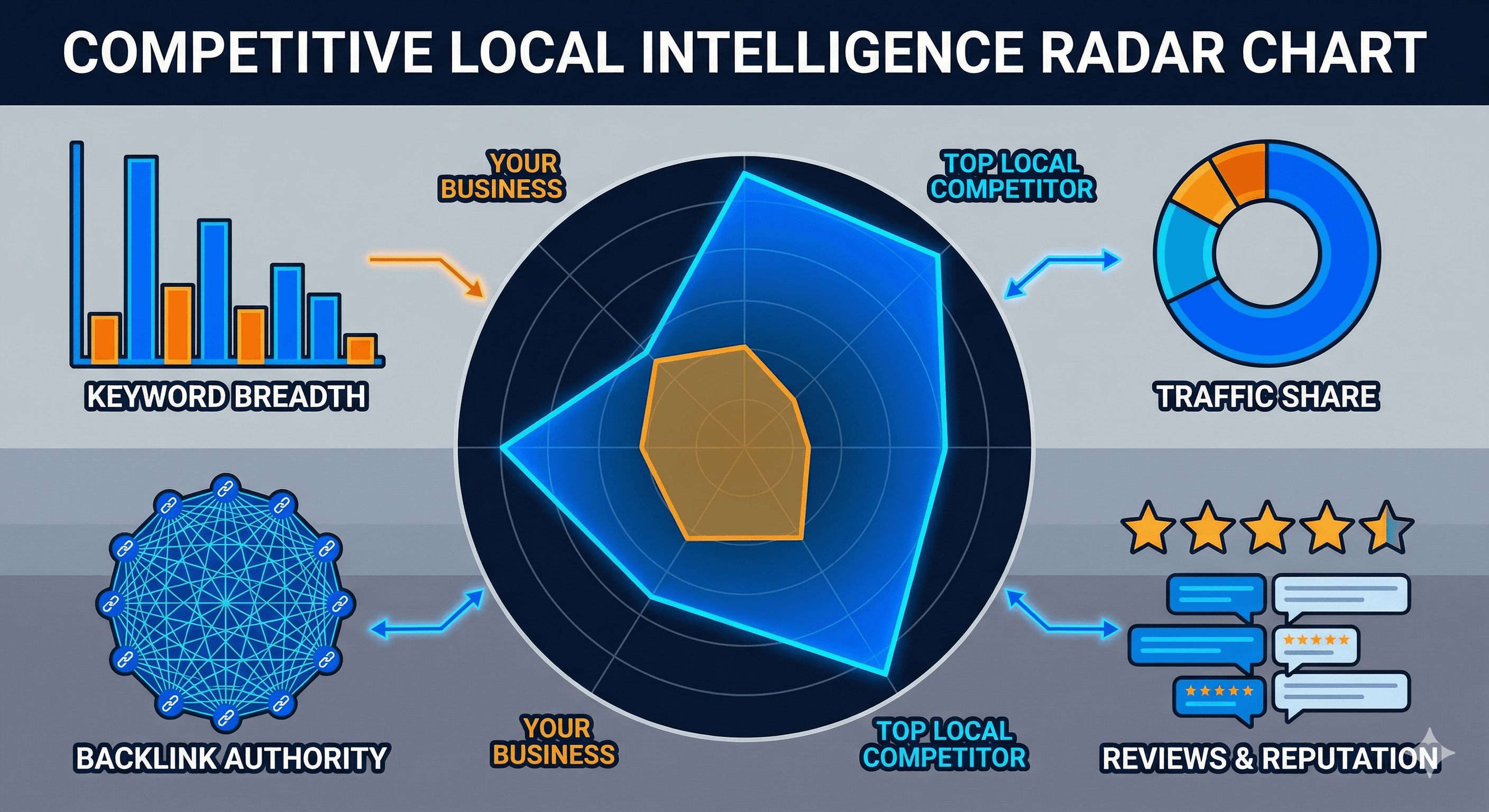
The diagram below is your competitive intelligence.
If you analyse your competitors from these angles, you will see exactly what they have optimized for. Congratulations, you now have a sharp sword. You can use it to build and targeted these gaps so you compete and win.
How Smart Research Impacts Your Entire Strategy
If you've been following along, you now understand how to analyse your competitors and know exactly how to find gaps where your competitors are vulnerable. Using this information, you are ready to go to war. Let what data you've found dictate how you use every other tactic and tool that you have at your fingertips.
Supercharging Your Google Business Profile Optimisation
Your Google Business Profile optimisation is affected by the keywords you choose for categories, description, and posts. After you analyse your competitors, your research will tell you if simply having "Landscaping" is enough, or if you need to focus more and double down on secondary categories like "Paving Contractor" or "Gutter Cleaning Service."
Laying the Groundwork for Dominating the Top 3 of Google
You want to rank in the Top 3 Map Pack. For this, Google needs to trust your business for a specific search keyword. The easiest way you can do this is to use keyword research to ensure that your primary service listed on your website matches the primary category on your GBP. If this also matches the implicit search, then you have a well-oiled, synchronised machine that is telling Google it can trust you.
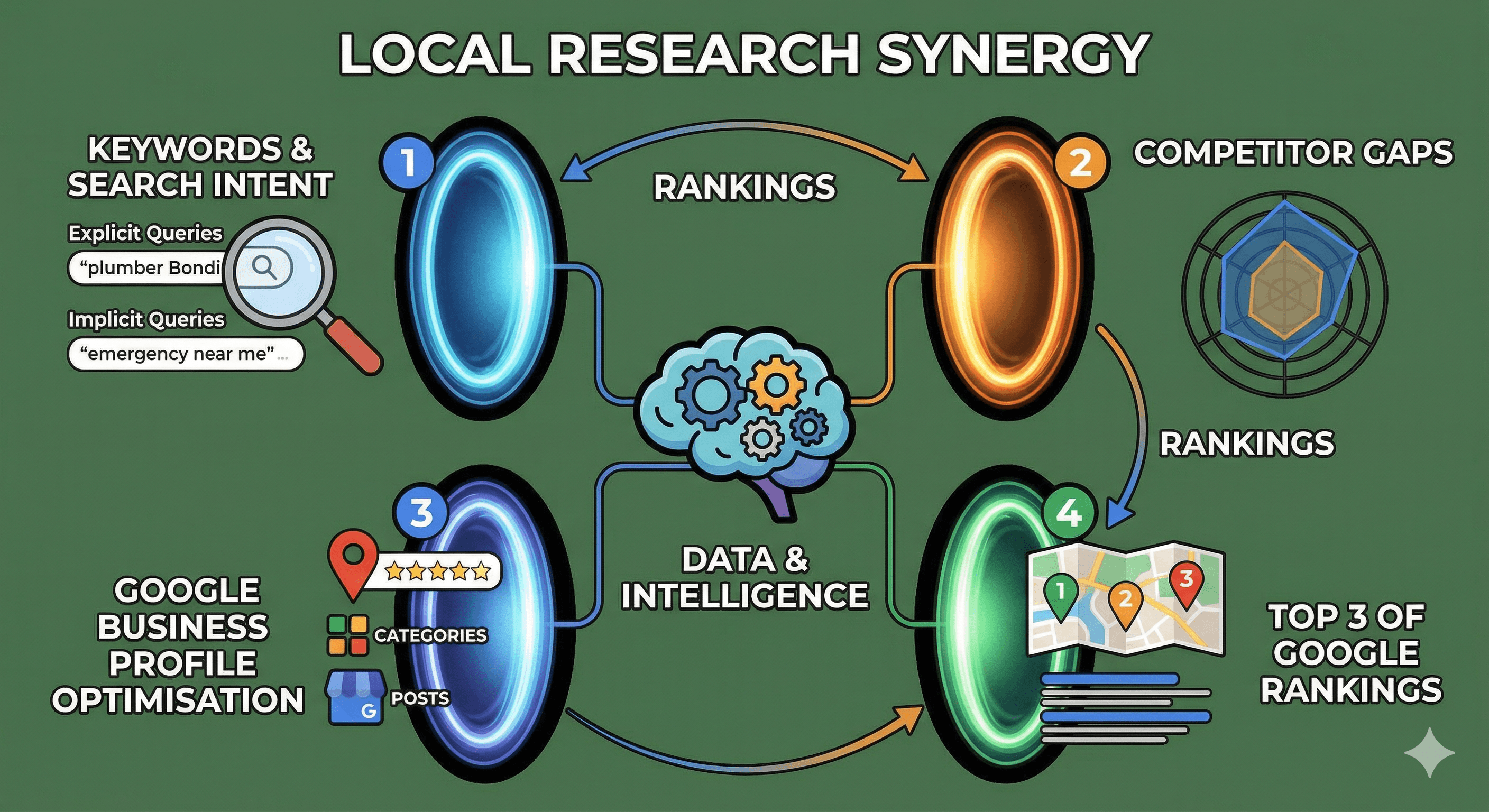
By having this synchronisation, you are also telling Google: "This business isn't just another plumber. He is the expert for blocked drains in Bondi."
The 5-Step Framework for Local Market Intelligence
So how do we do it for you? As the leading local marketing agency, we have a strict framework and specialised tools. It's worlds away from "guessing." and we're sharing the secrets with you below.
It's time to take all the theory you've just read and put it into action. Here is the 5-step roadmap for Local Market Intelligence. This will take you from simple discovery and confused with guesswork to a data-based, systematic plan that will get you higher on Google.
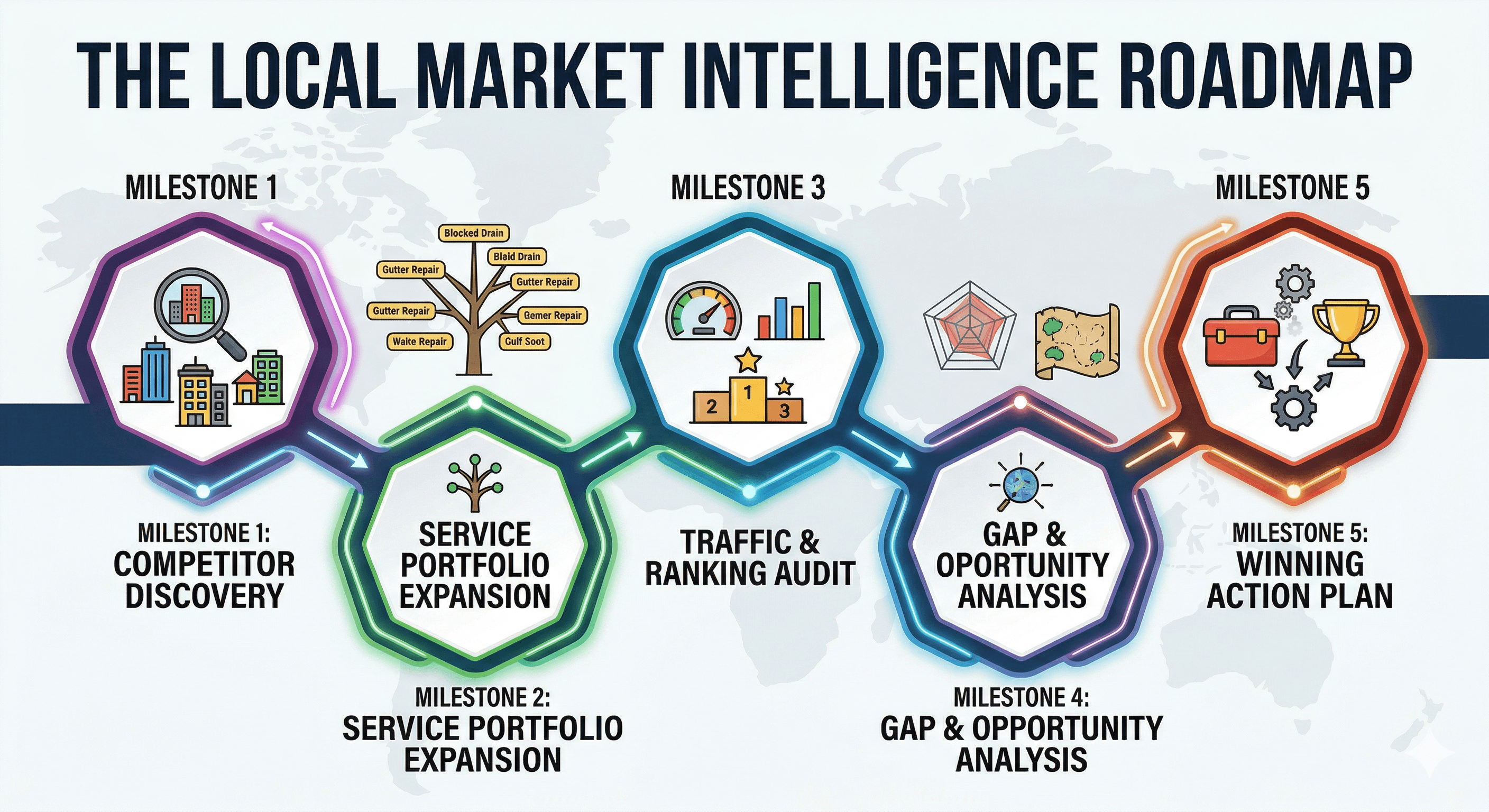
Step 1: Who Are You Actually Competing With?
Your competitors used to just be those down the street. In today's age, it actually is any company that is actively swiping or siphoning your search traffic. This could be a large franchise, a smaller disruptor and everyone in between in your local area. So you must identify who Google trusts the most for your core services in the area.
Step 2 : Creating Your Service Keyword Portfolio
Have you analysed your own business to understand every service you offer? For an electrician, you shouldn't limit yourself to "electrician Blacktown." Keywords like: "switchboard upgrades," "smoke alarm installation," "EV charger setup," "LED downlight replacement," and "flickering light troubleshooting." Can you see how these keywords create a portfolio for your business?
Step 3: Auditing Your Competitor Traffic and Rankings
After you've found your competitors, perform a deep dive on them. Don't only zero in on what keywords they rank for, you must also focus on which keywords are driving the most traffic to their site. This major distinction will save you hours by focusing on the keywords that actually result in phone calls.
Step 4: Uncovering Opportunity Gaps (Content and Citations)
Your probably feeling overwhelmed imagining all the work that your going to have to do, but what about "quick wins"? Can't we create a single service page to immediately compete for all the high-value, terms? The answer is yes, and this is found in implicit queries, localised suburb modifiers, and requires a deep analysis of content quality and citations and link building.
Step 5: Developing the Winning Action Plan
Lastly, you should prioritise what you've found. Now that you have a strategic roadmap. What keywords will should we optimize your GBP for? What specific service pages should be created first? What gaps need to be filled in your local citations? This 5 step guide means that every marketing dollar spent is aligned with the data, not guesswork.
Tool vs. Talent: Why a Marketing Agency is Worth the Investment
The internet has hundreds of keyword tools, infact, you can even generate 5,000 keywords from AI. So what value does hiring a local marketing agency bring to you?
Strategy Over Data Dumping
A list of 5,000 raw keywords is useless, overwhelming and doesn't tell you how to win.
Our Professional local marketing agency talent collects data, interprets it and then we look at a list of keywords and prioritize them based on search volume, commercial intent, location dynamics, and how this will affect your bottom line.
Imagine if you knew how to take that 5,000-keyword list and distill it into what actually moves the needle. Then made a strategic, 12-month content plan, citation campaign, and outlined how to do link building outreach. You need a strategic expert you need to make sense of the noise.
George and Bob are Electricians from Blacktown. Here's a Real Tale about their Real-World Scenarios
See if you understand why George is playing the guessing game and why Danielle is so much more successful.
Marketing Metric | Guessing Gordon's Electrical | Data-Driven Danielle's Electrical |
Primary Website Title | Gordon's Electrical - Blacktown | Switchboard Upgrades & EV Charger Installations Blacktown - Danielle's |
GBP Categories | Electrician | Primary: Electrician, Secondary: Lighting Contractor, Home Automation, EV Charger Installer |
Content Strategy | One "Services" page with a list. | Made dedicated service pages for 12+ specific services (e.g., "LED lighting install"). |
Top 3 Visibility | ranks #14 for "electrician Blacktown," invisible for specific services. | Ranks in the top 3 for "EV charger installer near me," "emergency electrician Blacktown," and "switchboard upgrade Parramatta." |
Phone Call Volume | Low, mostly emergency calls like flickering lights or sparking sounds at 3am. | High, People trust Danielle and are happy to pay a premium for their jobs. |
Frequently Asked Questions (FAQs)
1. How long will my keyword and competitor research project take? You could probably do a basic project, with a list of keywords that can be generated quickly. However, a professional, deep-dive combined with gathering local intelligence usually takes our marketing agency 1-2 weeks focused expert time. The results are a comprehensive strategy and a roadmap for your business.
2. Can I do keyword research for free? Yes certainly! You can use tools like Google Keyword Planner if you're willing to learn how to navigate it and verify an ad account, or you could use premium, specialised tools (like SEMrush, Ahrefs, and BrightLocal), which can cost hundreds of dollars per month and are not built for localised intent. They also do not discuss how to gain competitive intelligence, which is what really uncovers the true opportunity gaps.
3. What if my competitors don't have a website? That's ok, they may not have a website, but they definitely Google Business Profile (Otherwise you wouldn't be worried about them), we can still perform intelligence. Its still worth analysing their categories, services, posts, review sentiment, and citations. A professional marketing agency can still find their strategy. P.S. Congratulations on finding a gap in their strategy.
4. I know my customers; is keyword research really necessary? Yes. You know your typical customer, rather than every customer that needs your service. Also, what you call a service (e.g., "terracotta tile restoration") might be different from what your customers is actually searching for (e.g., "roof tile paint") and that data often yields surprising gaps in understanding intent. Remember, you are the expert. The customer has no clue and usually just fumbles around till they find out.
5. How often do I need to re-do my keyword and competitor research? You should do a deep-dive at the beginning of any local marketing campaign. After that, we recommend our advertising agency clients review their data every 1-3 months to account for changes in the algorithms, new service areas, new competitors and upgrading yourself.
6. There's a lot to do in the roadmap. Do I have to implement everything all at once? No. The roadmap is structured so you make the maximum impact. A good marketing agency will work at a speed you are comfortable to in order to implement the changes over 3-6 months. You should focus on the "quick wins" and high-impact changes first, then refine the nitty gritty later.
7. What will keyword research cost me? As a leading local marketing agency, we offer custom quotes based on your specific needs, typically ranging from $650 to $2500 for a deep-dive strategy. Get in touch with me by selecting a plan or by using the green button with my number on it at the top right. My team looks forward to speaking with you soon :)
Are You Ready To Stop Operating in the Dark?
If you are still relying on hope and referrals only, then you are leaving your businesses growth to something entirely outside your control. Instead, if you take the time or hire a marketing agency for professional local keyword analysis and competitor research for your digital strategy, you'll move from guesswork to certainty.
You'll claim your rightful spot in the top 3 of Google and give Google exactly what it needs in order to keep you there. It's really simple, you just have to be an undeniably relevant, trustworthy local business.
If you are a local service business owner ready to stop leaving money on the table and start winning, we are the specialized marketing agency for building your digital footprint.
Check out our packages for one that suits you, lets have a discovery call and then we'll turn the turn data into dollars.


